Confronting Carceral Systems in Brooklyn
Graduate Research, Abolitionist PlanningWanting to bring to light the ways in which carceral systems surround us, this art piece visually confronts the reality of Brooklyn’s web of carceral facilities. Using mapping, design, and spatial research, my team and I created a layered visual narrative that highlights how jails, prisons, detention centers, and police infrastructure are embedded in the everyday fabric of our neighborhoods. The work encourages viewers to question what is considered "public safety" and who is being protected or surveilled. It functions as both an art object and a conversation starter, helping communities see how structural power manifests physically and invisibly in the built environment.
Introduction
Carceral systems surround us, but some are more overt than others. We wanted to make the invisible visible, while simultaneously bringing attention to the new Brooklyn Borough Jail through interrupting people's interactions with the active construction site. This site is located on Atlantic Avenue in Downtown Brooklyn, one of the borough's busiest thoroughfares, and is soon to be home to a purportedly 'more humane' borough jail. The $3 billion, 1,000-bed facility has been controversial since the announcement of its creation and the 'borough-based jail' system it's a part of the building's design is modern and is slated to have a 30,000 square foot 'community space' on the first floor. This art and research project asks whether the integration of a carceral space in the built environment works to move towards abolition or if these projects simply conceal inhumane treatment in an attempt to make the carceral system more palatable, rendering it invisible.
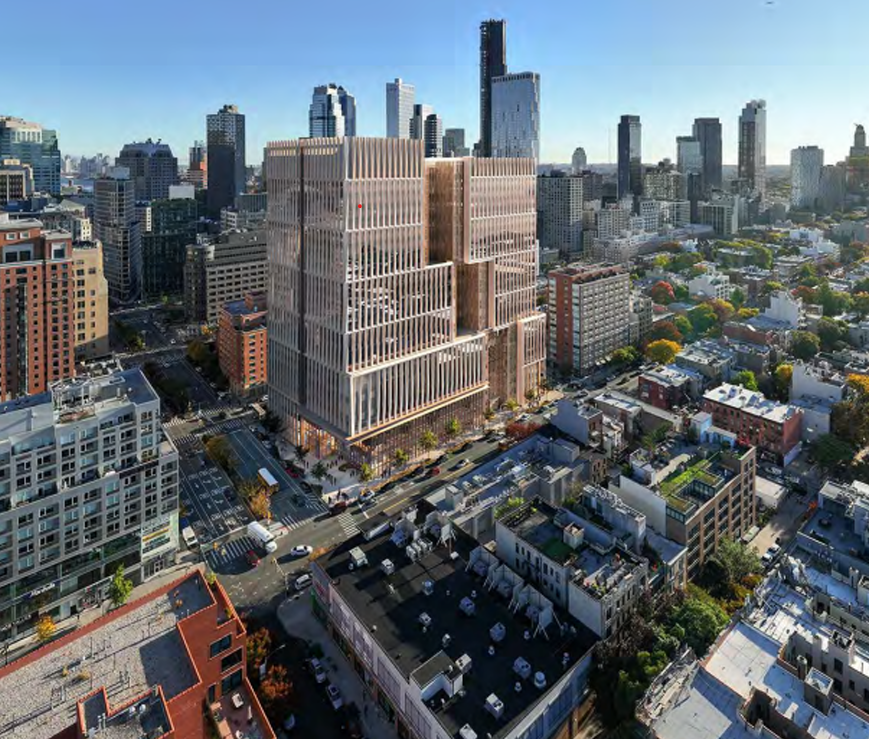
Rendering of the New Facility from Department of Design and Construction
Methodology
We wanted to investigate other city-owned buildings made invisible by the system that contribute to the larger carceral system. Using publicly accessed citywide facilities data, we combed through a list of ~600 city-owned facilities to investigate the extent of the city of New York's carceral systems. We used a broader definition of carceral systems, inspired by Disability Justice and Abolition which confronts the reality of carceral systems reaching beyond jails and includes things like hospitals and after-school programs. While facilities data contains subgroup data (like 'parking,' 'historical sites,' and 'parks') these designations don't accurately describe a more holistic definition of carceral systems. We identify carceral systems and facilities as spaces where people are detained, confined, surveilled, or controlled. This can sometimes include hospitals, after-school programs, and social services, especially those that work directly with agencies like the NYPD or ICE. This methodology helps bring to light the realities of how our built environment oftentimes helps keep the carceral state hidden and invisible.
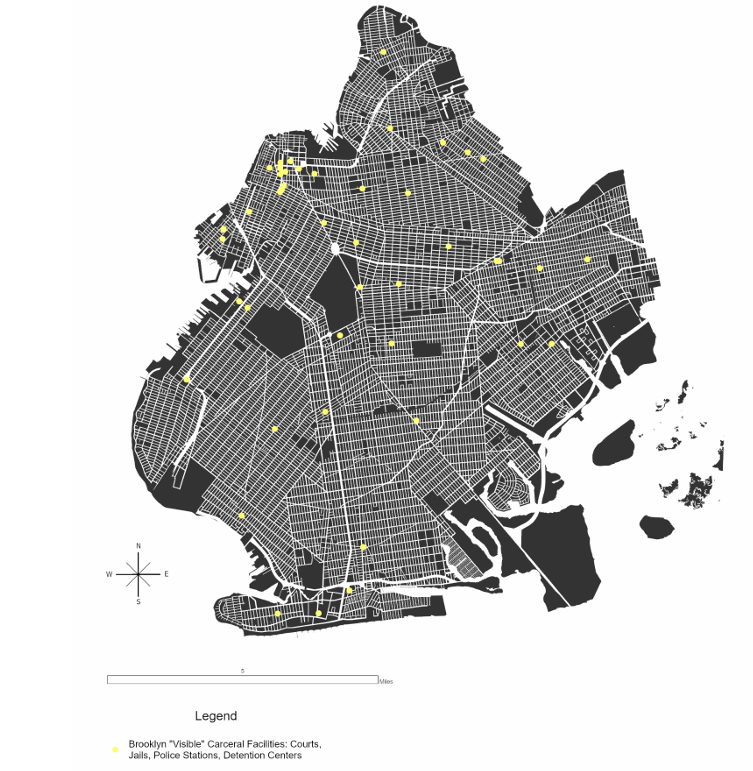
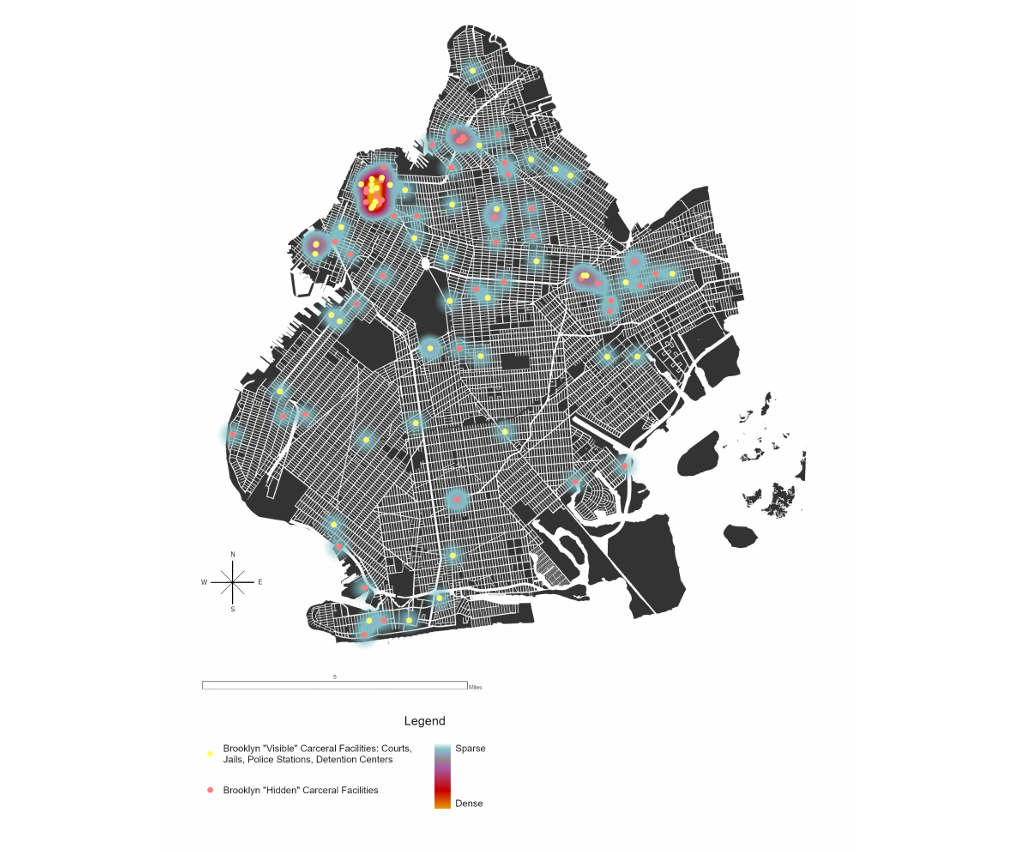
First, we mapped 'visible' carceral facilities in Brooklyn. This illustrates overt carceral systems such as police stations, jails, and detention centers.
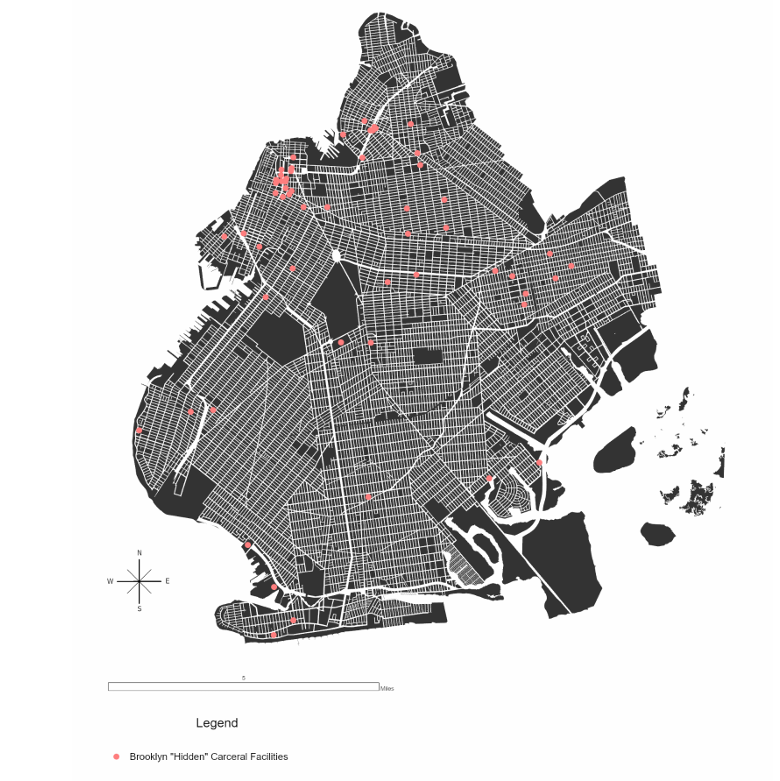
Then, we explored 'hidden' carceral facilities, those that are more covert, including NYPD affiliated after school programs or mental health facilities that participate in involuntary hold policies
Together, the 'visible,' and 'invisible' start to paint a clearer picture of the Brooklyn carceral landscape.
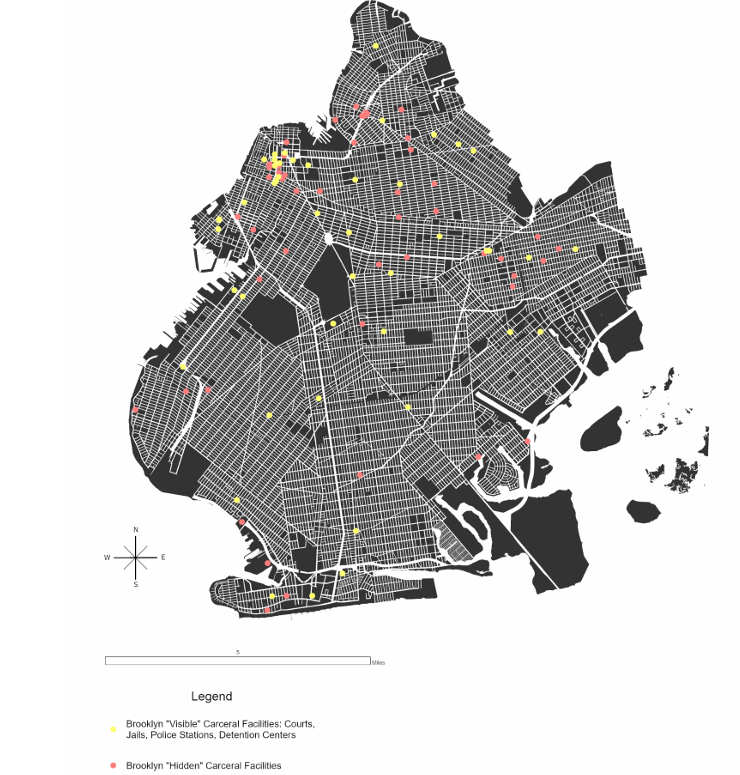
We finished with a heat map to show the density of both overt and covert carceral facilities in Brooklyn which was displayed on our final poster. The new Brooklyn Borough jail is to be located in the cluster of the highest density of carceral facilities.
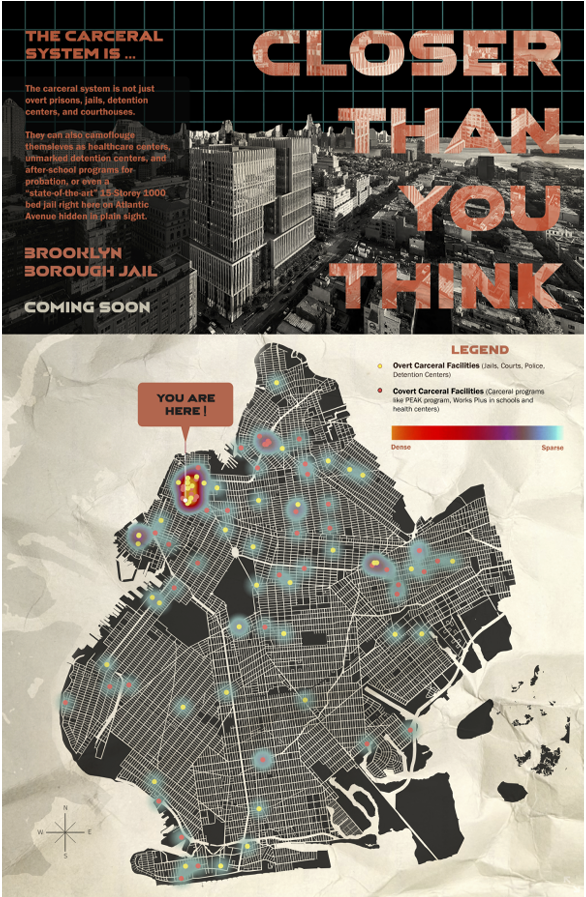
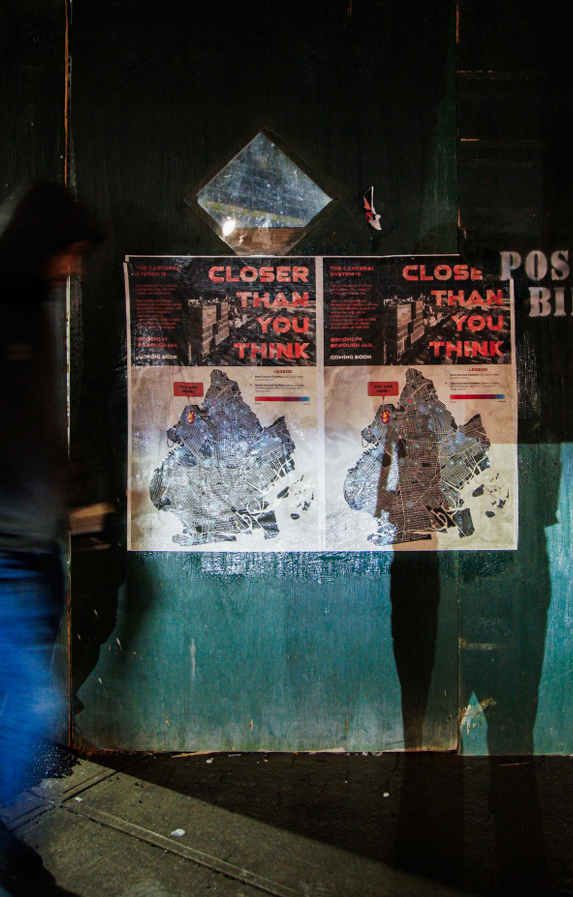
The poster was displayed at the site of the new jail to bring awareness to the realities of the system.
Findings
Digging through the facilities data revealed many covert carceral spaces in Brooklyn alone. We have highlighted four to illustrate the ways in which 'invisible' carceral facilities hold up the larger system in nefarious ways. Brooklyn Youth Court: Many ‘reform’ efforts further perpetuate the institutionalization of the carceral state. For example, the Brownsville Youth Court is a public/private organization that casts teens in the roles of jurors, judges, ‘youth advocates’ and ‘community advocates’ (defense and prosecution, respectively) to hear the real-life cases of their peers, who have been accused of committing low-level offenses. The participants then decide the appropriate ‘sanctions’ or sentencing for the youth –– with no possibility of exoneration, nor a discussion of any contextual or systemic forces that may have led to committing the ‘offense.’ Instead of opposing and preventing conditions that lead to the school to prison pipeline, programs such as BYC normalize involvement and cooperation with law enforcement at an impressionable age. Problematic when one considers that “the majority of criminal defendants agree to plead guilty in return for lesser prison terms, even when innocent or believing themselves innocent of the charges” (Story, pg. 65).
PEAK Program: PEAK (Pathways to Excellence, Achievement, and Knowledge) is an education-centered alternative-to placement program in NYC, designed for youth aged 15–18 involved in the juvenile justice system—specifically those on probation, facing violations, or re-arrested for felonies. It runs in partnership with the Department of Probation, Department of Education (schools), and community-based organizations (CBOs). It offers year-round academic, behavioral, and therapeutic support. Though PEAK is framed as a rehabilitative initiative, it remains deeply embedded in carceral structures by operating within the probation system, ultimately reinforcing surveillance and control rather than dismantling them. Access to the program is limited to youth already involved in the justice system, with eligibility based on probation status and duration—an approach that reinforces exclusion and neglects the broader needs of marginalized communities. Its focus on behavioral compliance and job readiness may further prioritize productivity and conformity over critical thinking and liberation, aligning with punitive norms instead of challenging them. While PEAK partners with community based organizations, ultimate authority rests with the Department of Probation, limiting authentic community leadership and contradicting the abolitionist vision of education driven by care, autonomy, and collective empowerment. In essence, PEAK may offer short-term alternatives to incarceration, but its carceral underpinnings and emphasis on compliance fall short of the transformative, liberatory goals central to abolitionist education.
Works Plus Program: Similarly, the Works Plus program, administered by the NYC Department of Probation (DOP), aims to provide flexible work readiness and wraparound services to young adults aged 16 to 30 who have been impacted by gun violence. Participants are referred through the city's Crisis Management System (CMS), and the program offers individualized support, including career awareness, educational opportunities, vocational training, and case management, with an emphasis on soft skills and life skills development. While the program presents itself as rehabilitative, it still operates under the criminal justice system and sustains carceral oversight. Access is conditional, reinforcing exclusionary and punitive dynamics. Its emphasis on productivity over critical awareness risks reproducing compliance-based norms. And alas, the state oversight undermines genuine community autonomy. Ultimately, despite its supportive goals, Works Plus reflects carceral structures more than it challenges them, falling short of the transformative, community-driven change that abolitionist pedagogy envisions.
Passages Academy: Passages Academy is a NYC DOE school that operates in partnership with New York City Administration of Children Services (ACS), Division of Youth and Family Justice (DYFJ), and Office of Youth and Family Development (OYFD) for "court-involved youth", who are entrusted to the "care and custody" of these agencies. Passages Academy is just one school operated by District 79: Alternative Schools & Programs, which aims to provide children and youth impacted by the carceral system an "alternative learning" environment. While these programs connect students to post-secondary opportunities including Cooperative-tech training programs, incarceration is inextricably tied to the youth-education experience. Programs are compulsory and liaised by the courts and DOE, and the youth education experience is framed and reinforced in response to incarceration. These programs and facilities exemplify the ways in which the carceral system and police state infiltrate our daily lives, oftentimes without our knowing. Raising awareness around the wide reach of our punitive justice system is an initial but essential step in the fight for a world without cells, detention centers and the dehumanizing effects of incarceration.