National Zoning Atlas
research, zoning code analysis
The National Zoning Atlas is a countrywide project that demystifies and democratizes zoning data to support more transparent and equitable land use. I analyzed and synthesized 16 districts and 238 pages of zoning code for a jurisdiction in New York State, contributing to this essential work. I was struck by the often-overlooked power of zoning code as a tool for protecting local ecosystems and shaping resilient landscapes. This research deepened my understanding of how land use regulation intersects with habitat conservation, climate adaptation, and environmental justice.
See the full breakdown here
ZONING ATLAS ANALYSIS AND FINDINGS
TOWN OF NEW PALTZ, ULSTER COUNTY NY
Executive Summary:
Concerned with the accuracy in which the New Paltz zoning code ladders up to the comprehensive plan's goals, and curious about how the code compares to Ulster County’s existing land use regulations, this brief analysis interrogates three main findings about the code. While the Town of New Paltz does show some progressive tendencies with things like ADUs (although they do require public hearings) and little to no parking requirements, its restrictive stance on multi-family housing and lack of mandatory affordable housing contradict its state goals of housing affordability. The upcoming new comprehensive plan creation provides an opportunity to align zoning with these goals and create a more equitable community.
Findings
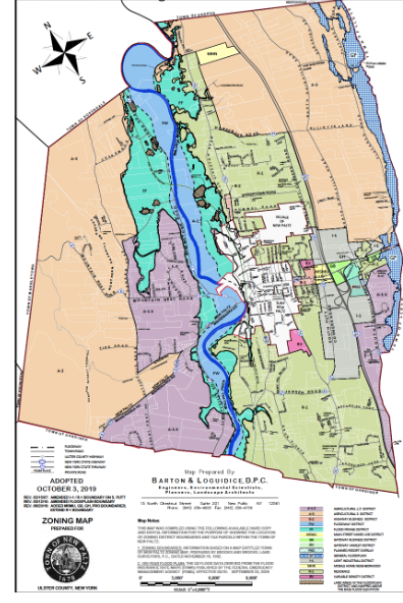
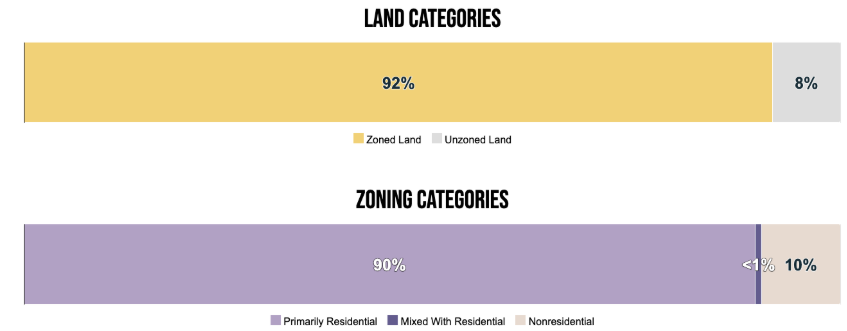
The Town of New Paltz in Ulster County is made up of 16 distinct districts of land use. The area is unique in that the Town of New Paltz envelopes the smaller Village of New Paltz. While the two jurisdictions share a comprehensive plan, they currently have different zoning codes. The area is also home to a college, SUNY New Paltz, adding an even richer landscape to this area. This brief analysis seeks to interrogate the zoning code in relation to the area’s own master plan as well as the larger county.
Figure 1. Zoning Map of New Paltz
The Town of New Paltz Zoning vs. Larger Ulster County Zoning
In order to more clearly position the Town of New Paltz within the larger Ulster County, it is valuable to compare critical policies such as ADUs, single-family homes, multi-family homes and middle housing, and special provisions.
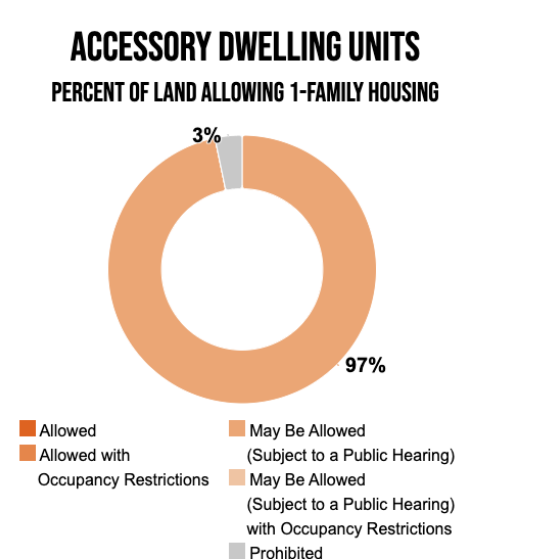
In regards to Accessory Dwelling Units (ADUs) 97% of land allowing 1-family housing in New Paltz also allows ADUs (with a public hearing), whereas in Ulster County as a whole, only 37% of all land allowing 1-family housing also allows ADUs. This finding may lead planners and residents to believe that perhaps New Paltz is more progressive than its surrounding county, and may be more open to creative solutions regarding housing density, however, it is worth noting that the addition of a public hearing in the process makes the possibilities of building ADUs slimmer than they would be without the public hearing component.
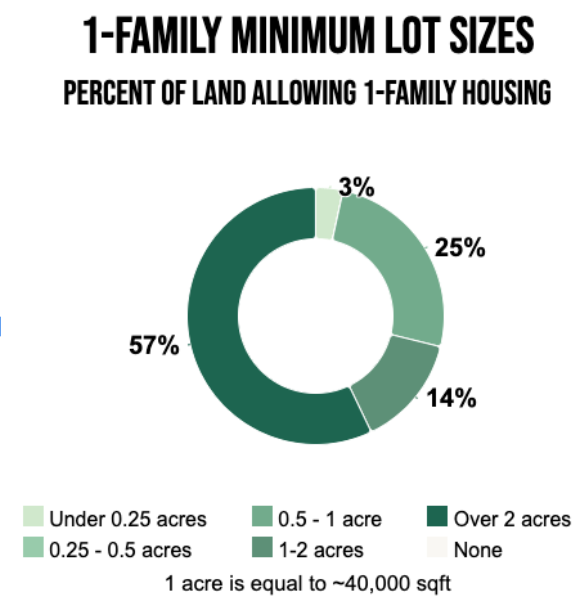
Single-family homes appear to be more widely accepted in both the county and the Town of New Paltz, with 93% of all residential land in Ulster County allowing single-family housing as-of-right, and 99% of all residential land in New Paltz allowing single-family housing as-of-right. Although single-family housing is abundant in both the county and the jurisdiction of study, this speaks to the priorities and makeup of the area as a whole. These data points show that both New Paltz and Ulster County as a whole prioritize single-family housing. This finding, in contrast to the previous data point, points to a much more traditional, exclusive zoning landscape.
Further data also points to a more exclusive and conservative zoning philosophy, specifically findings around 2-family housing and begins to paint an even clearer view of the priorities of New Paltz. In the Town of New Paltz, 2-family housing is entirely prohibited while in Ulster County as a whole, 60% of all residential land allows 2-family housing as-of-right. Both these findings speak to the larger trend where municipalities are critically missing ‘middle housing’ which is critical to affordable, equitable cities.
When interrogating special provisions, parking requirements stand out. A mere 1% of residential land in the Town of New Paltz has parking requirements while 94% of residential land in Ulster County has parking requirements. This lack of parking requirements points to progressive priorities regarding walkability and sustainability.
Overall, in relation to the larger county, the Town of New Paltz is contradictory and inconsistent, perhaps implying that the area has its own unique goals when it comes to land use and zoning. Broadly speaking, the Town of New Paltz is slightly more progressive in its housing policy through its flexibility regarding ADUs, although the jurisdiction is still somehow exclusionary, as shown through the abolition of all 2-family housing. It also appears that environmentally the town is significantly more progressive and prioritizes more walkable areas when looking at parking policy.
The Town of New Paltz Zoning vs. the Comprehensive Plan
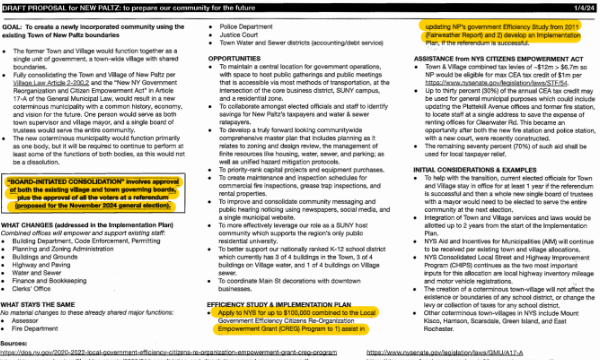
The comprehensive plan for New Paltz was last updated in 1995, while the zoning was updated in 2019. Rather than compare the updated zoning to the outdated comprehensive plan, this analysis opts to compare the current zoning to the draft proposals for a new comprehensive plan currently in progress. One significant proposal is to combine the village and town of New Paltz as one municipality in the comprehensive plan (see Figure 2).
Figure 2. Part of Draft Proposal for Updated New Paltz Comprehensive Plan, 2024
Furthermore, the new master plan hopes to stop and reverse the increasing unaffordability of the area while maintaining ecological preservation. Early conversations around this reimagining reveal that housing will be a dominant issue moving forward, specifically the issue of affordability. The county as a whole currently has a ‘housing-smart community program’ and town officials are currently recruiting residents to form a committee to guide the initiative. Recent measures include tighter short-term rental regulations, eased ADU requirements, and a large-scale rental project aimed at serving SUNY New Paltz students. This particular project does align with the 1995 plan which aimed to prioritize densifying near the Village of New Paltz to protect and preserve the rich rural and natural environment surrounding the area, but prioritizing student housing raises questions around who exactly the affordable housing is for. In addition to housing, the new master plan may explore overlay zoning for rural areas to minimize habitat fragmentation while maintaining the current housing capacity. This does not necessarily reflect the goals of the 1995 comprehensive plan which aims to “...accommodate present and future population by encouraging the development of an appropriate variety and quantity of sound housing which will serve various income levels and age groups, including low and moderate-income housing.” While the current zoning allows affordable housing if the board wants it, perhaps the new plan should make affordable housing mandatory to better address this important issue. As concerns around affordable housing rise, so does the town’s tax levy, which almost doubled between 2016 and 2024. Despite complaints about price, essential services provided due to property taxes have generally been supported by locals.
Sources:
National Zoning Atlas. Zoning Atlas. Accessed December 9, 2024.https://www.zoningatlas.org/atlas.
Town of New Paltz. Code of the Town of New Paltz. eCode360. Accessed December 9, 2024.https://ecode360.com/9168681.
Town of New Paltz. Town of New Paltz Master Plan. 1995.https://www.townofnewpaltz.org/sites/g/files/vyhlif3541/f/file/file/masterplan1995.pdf.
Ward, Terence P. "What’s Ahead for the Town of New Paltz in 2024?" Hudson Valley One. December 26, 2023.https://hudsonvalleyone.com/2023/12/26/whats-ahead-for-the-town-of-new-paltz-in-2024/.
Appendix
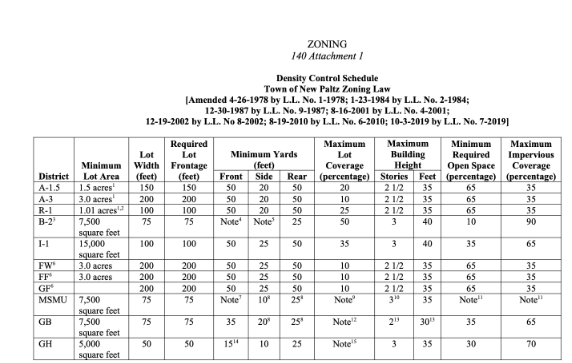
Current Density Control Schedule for the Town of New Paltz
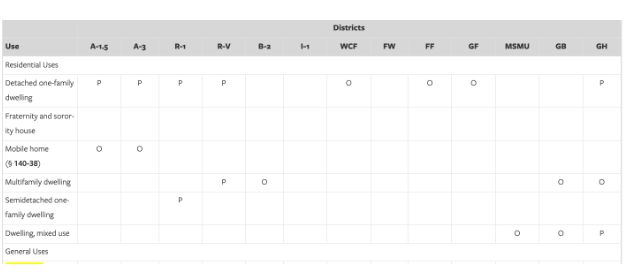
"P" designates a use permitted by right.
"O" designates a use permitted subject to additional standards pursuant to § 140-52 of this chapter by the Planning Board.
"S" designates a special permit use contingent on securing special permit approval in each case from the Planning Board]